If you’ve ever tried to recruit a qualified MOT tester, you’ll know it can feel a bit like hunting for a unicorn in a high-vis jacket. Good testers are hard to find, even harder to tempt away from where they already are, and the moment one hands in their notice, your booking diary feels it.
Here’s the good news…
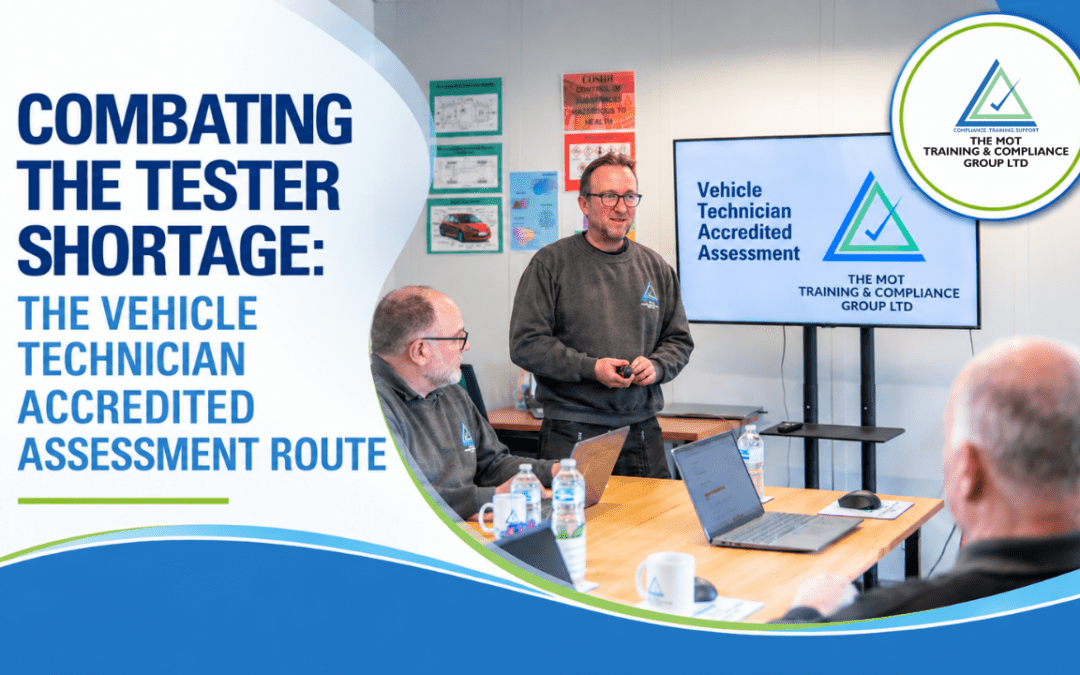
The answer to your MOT tester shortage might already be standing in your workshop, spanner in hand. Plenty of garages have brilliant, experienced technicians who know their way around a set of brakes better than anyone, yet they can’t test simply because they don’t hold the right piece of paper. That’s exactly the gap the Vehicle Technician Accredited Assessment, or VTAA, was designed to close.
In this guide, we’ll walk you through what the Vehicle Technician Accredited Assessment is, who it’s for, and how you can use it to turn your experienced, uncertified techs into fully qualified MOT testers.
The MOT Tester Shortage Is Closer to Home Than You Think
When you’ve only got one or two testers, you’re always one sick day, holiday or resignation away from turning MOT work away. It’s a stressful way to run a station, and it puts a lot of pressure on the testers you do have.
Now think about the people already on your team. You might have a technician who learned everything on the job and never went to college. You might have someone whose certificates went missing years ago, or a skilled mechanic who trained in another country. They’re capable, they’re trusted, and they already know your workshop inside out. The only thing standing between them and the MOT bay is the qualification requirement.
DVSA asks anyone who wants to test class 3, 4, 5 or 7 vehicles to hold an accepted qualification or accreditation, typically at Level 3. For a lot of experienced techs, going back to college for a full Level 3 isn’t realistic. That’s where the light vehicle inspection route comes in.
What Is the Vehicle Technician Accredited Assessment?
The Vehicle Technician Accredited Assessment, also known as Light Vehicle Inspection (LVI), is a one-day course designed for technicians whose job involves the inspection, maintenance and repair of light vehicles. Rather than teaching them from scratch, it gives them the chance to prove the skills and knowledge they already have.
Once a technician passes, they’re considered equivalent to someone who has studied to Level 3 through a qualification route, and the VTAA appears on DVSA’s list of accepted qualifications and accreditations for the MOT tester course. It’s also a lifetime achievement, so it won’t need renewing down the line.
The course itself is a mix of classroom and workshop time. Candidates complete an online assessment alongside practical assessments covering brakes, suspension and steering, wheels and tyres, emissions and electrics. None of it should come as a shock to an experienced tech. It’s about showing what they can do, properly and on record.
Who’s Eligible for the Light Vehicle Inspection Route?
Before anyone can take the MOT tester course, DVSA has a few eligibility rules they’ll need to meet. Your technician must be a skilled mechanic with at least four years’ full-time employment servicing and repairing the types of vehicles they’re going to test. They’ll need a current and full UK driving licence for those vehicle classes, no unspent criminal convictions, and they must be considered ‘of good repute’, which is something DVSA decides. We also ask candidates to be able to pass a basic DBS check.
The four years’ experience is usually where most questions crop up, so it’s worth having a friendly chat with your technician about their work history before you book anything. If you’re not sure whether someone ticks every box, give us a shout first and we’ll talk it through with you. It’s much nicer to find out early than on the day.
From Workshop Tech to MOT Tester: The Route Step by Step
So, what does the journey actually look like? Here’s the route from start to finish.
Step 1: Check eligibility
Run through the DVSA requirements above with your technician. Experience, driving licence, convictions and good repute all need to be in order before you go any further.
Step 2: Complete the Vehicle Technician Accredited Assessment
One day of classroom and workshop assessment, and your technician comes out with recognition equivalent to Level 3. You’ll find upcoming dates and the application form on our VTAA course page.
Step 3: Take the MOT tester qualification course
With the VTAA under their belt, your technician can move on to the IMI Level 2 MOT Tester course. According to GOV.UK, the course for class 4 and 7 vehicles (group B) lasts at least 29 hours, including at least 8 hours of practical training. It covers safe working practices, working relationships in the test centre, professional development, pre-test checks and carrying out an MOT test, and finishes with a multiple-choice test and a practical assessment. Pass both and they’ll receive their Level 2 MOT Testing Award.
Step 4: Pass the DVSA demonstration test
Their Level 2 certificate lets them book a DVSA MOT demonstration test. This is the final hurdle before they can test on their own.
Step 5: Start testing, and keep learning
Once they’ve passed, they can start carrying out MOT tests at your authorised testing station. From then on, they’ll need to complete annual training and assessment every year to stay current. If you’d like them to test class 3 or 5 vehicles later on, they’ll need their group B award and demonstration test first, followed by the class 3 or 5 training.
Why Growing Your Own Testers Makes Good Business Sense
Training up someone you already employ has some lovely knock-on benefits. The most obvious is capacity. Another tester means more tests, more flexibility when someone’s on holiday, and a lot less panic when the diary fills up.
There’s loyalty too. Investing in someone’s progression tells them you value them, and people tend to stick around where they feel valued. A technician who becomes a tester with your support is far more likely to stay with you than one you’ve had to poach from down the road.
It’s also good news for your compliance. A tester who has grown up in your workshop already knows your standards, your processes and the way you like things done. You’re not starting from scratch with someone else’s habits. At £650 plus VAT, the VTAA is a modest investment in someone who’s already proved their worth to you.
Getting Your Team Ready for the Vehicle Technician Accredited Assessment
Choosing the right person matters. Technical skill is essential, of course, but so is attitude. The best testers are careful, honest and pay attention to detail, so think about who on your team shows those qualities day in, day out.
It’s also worth remembering that some of your most experienced techs may not have sat in a classroom for years. A few nerves are completely normal. Reassure them that the VTAA is about recognising what they already do well, encourage them to brush up on the five assessment areas, and make sure they’ve got cover so they can focus fully on the day.
Finally, talk them through the whole journey, not just the first step. Knowing there’s a clear path from the VTAA to the MOT bay makes it much easier to stay motivated.
Ready to Tackle Your MOT Tester Shortage?
If you’ve got an experienced technician who’s ready for the next step, the Vehicle Technician Accredited Assessment could be the simplest way to grow your MOT team without the headache of recruitment. Courses run regularly, and you can find the latest dates and the application form on our VTAA page.
Not sure if it’s right for your team? Get in touch and Karena will be happy to talk it through with you. We’d love to help you build a team of testers you can be proud of.